Long regarded—rightly so—as a safe haven for wealth preservation, luxury real estate has now emerged as a mirror of the aspirations of the world's great fortunes. Entrepreneurs, in particular, project far more onto it than a simple investment: their approach has become more introspective, reflecting a search for meaning that is anything but moralistic. It signals a natural evolution in the priorities of an international clientele amid profound change.
Transmission, innovation, long-term value creation, and coherence between legacy, family, and impact are shaping the property choices of UHNWI buyers. These concerns reflect a desire to anchor their wealth within a broader horizon, where material heritage intersects with intangible legacy.
This shift is visible across all regions in which BARNES operates. Everywhere, the notion of "year-round living" is gaining ground, redefining the boundaries between residence, refuge, and identity. The rise of "four-season cities" illustrates this transformation perfectly. The transition from resort to residence marks a deeper sociological shift. Destinations once viewed as seasonal are evolving into permanent places to live, supported by fluid international mobility, upgraded infrastructure, and a growing desire for continuity in lifestyle. Real estate is no longer just a sanctuary—it has become the foundation upon which family, professional, and emotional balance is built.
In a world where geopolitical tensions are resurfacing and a new equilibrium is taking shape between the United States, China, and Europe, property has become more than a safe-haven asset—it has become a supreme value. Symbolic, because it offers a meaningful place to bring together loved ones and future generations. Strategic, because it ensures long-term resilience of wealth. And pragmatic, because houses, villas, chalets, private mansions, or châteaux are desirable only when they offer solid fundamentals: durability, prime location, impeccable architectural quality, and contemporary comfort that combines noble materials, connectivity, environmental aspirations, and leisure amenities.
In 2025, BARNES' 144 offices across 22 countries observed the same dynamic: luxury real estate continues to follow emotional, practical, and financial criteria. But above all, it now meets a new requirement: an investment endowed with meaning. A personal, familial, and patrimonial meaning, guiding entrepreneurs in a world where stability is increasingly built around a place, a home, and a chosen anchor.
"In the world of luxury, one must rely on heritage." — Bernard Arnault, CEO of LVMH
The search for meaning is redefining the very notion of luxury
Driven by evolving societal expectations and the rise of new generations of consumers—particularly HENRYs (high earners, not rich yet)—the quest for meaning and the need for transmission are emerging as key factors influencing all segments of the luxury market, starting with high-end real estate. A major structural trend shaping this evolution is the unprecedented intergenerational wealth transfer expected by 2040, estimated at $84 trillion, according to the World Economic Forum. This shift is redefining investment priorities, especially among heirs from Generations X, Y and Z, who increasingly favor assets aligned with their personal values.
In the realm of luxury real estate, this movement translates into an ethical repositioning in which the property becomes a cultural and family asset—rooted in history and designed to endure across generations. As a result, historical residences, country estates and architecturally significant properties are once again at the forefront of demand, sought by buyers who aspire to a tangible legacy as much as to potential financial appreciation. This trend is consistent across major European markets, as well as in North America and Asia. Despite a challenging economic environment, exceptional properties demonstrate remarkable resilience and continue to attract steady demand.
Anticipated property transfers—often structured legally to minimize tax (and family) friction—lead buyers to favor homes built to last, capable of hosting multiple generations, and aligned with a more responsible long-term approach to wealth stewardship.
Despite their relatively small numbers, UHNWI accounted for 21% of all individual spending on luxury goods in 2024, totaling $290 billion. Spending on private jets and yachts is by nature almost exclusively attributable to UHNWI, while more than half of all fine wine purchases come from this segment. UHNWI favor experiences and purchases that provide meaningful experiences, leading them to spend over $25 billion annually on luxury hospitality and nearly $20 billion on fine art.
What if Hermès had figured it all out?
Hermès' success rests on the strict adherence to its historical values: French artisanal craftsmanship, constantly renewed creativity, and impeccable quality. Saddlery and leather goods are hand-assembled in France by artisans who must complete two years of training before working with leather. According to the brand, each product is entirely assembled by a single artisan to ensure its longevity.
Hermès also emphasizes responsible production, notably through an integrated repair service designed to extend the lifespan of products that can be passed down through generations. These values resonate strongly with the Chinese market, where the government has taken measures against ostentatious displays of wealth, directly reinforcing Hermès' timeless brand image. As a result, while the global luxury market declined in 2025, Hermès reported a 5% increase in revenue in the third quarter.
The quest for meaning: 10 defining codes
- 01 – Quality of life above all. The ultimate luxury is no longer ostentation, but reclaimed time. A preserved environment, climate, safety, and access to nature and essential services are redefining a destination's attractiveness.
- 02 – Uncompromising excellence. Architecture, amenities, craftsmanship, materials, and services: excellence remains an absolute prerequisite. It is now expressed through restraint, sustainability, and coherence.
- 03 – Education as a priority. Choosing a property also means choosing an educational ecosystem. The quality of schools, international outlook, academic excellence, and the transmission of values now weigh as heavily as the address itself.
- 04 – Transmission as a long-term vision. Buying is no longer just about ownership, but about passing on. Asset value, legal structuring, and an intergenerational perspective have become central.
- 05 – Security in the broadest sense. Personal, legal, political, and economic security. In an uncertain world, luxury real estate reassures through its solidity and resilience.
- 06 – A controlled and transparent tax framework. The quest for meaning also involves rationality. UHNWI favor stable, understandable tax environments aligned with a long-term wealth strategy.
- 07 – The meaning of the place. Sought-after properties tell a story. Heritage, cultural identity, and authenticity take precedence over standardization.
- 08 – The freedom to choose. "Four-season cities" embody this chosen mobility. Hybrid residences, remote work, and global connectivity are redefining lifestyles.
- 09 – Harmony between private and professional life. Real estate becomes a place of convergence. Integrated workspaces, services, and balanced rhythms of life are now essential.
- 10 – Responsible sustainability. Energy performance, intelligent renovation, environmental respect, and landscape integration are no longer optional; they are self-evident.
The virtues of holistic advisory
Luxury real estate has many faces! Beyond city apartments, lofts, penthouses, and townhouses, demand naturally extends to country family homes, mountain chalets, and seaside villas. In a context where remote work is becoming widespread, these properties increasingly tend to be suitable for long-term living and could, who knows, become genuine primary or secondary residences.
The most sought-after properties are those that have remained true to their history. Buyers are particularly attached to properties that faithfully reflect the architectural style of their country or region. "While properties in need of restoration still have their enthusiasts, demand is increasingly focused each year on homes requiring little to no work. Ideally, buyers seek properties with a sound main structure, allowing them simply to personalize and furnish it. What we call 'ready-to-decorate'," explains Olivier Brunet, Associate Director of BARNES Properties & Châteaux.
Yachting represents another extension of luxury real estate, a segment that continues to gain ground in the first half of the 21st century. "Whether sailing or motor, what often begins as a personal passion usually evolves into a family story," says Inigo Nicholson, CEO of BARNES Yachting. "I recently sold the 14th yacht in 35 years to the same American family—the first to the grandparents, this latest one to the grandchildren. On a yacht, whatever its size, level of luxury, or equipment, you are at the heart of intergenerational transmission of core values: sport, nature, mutual respect, and the joy of being together."
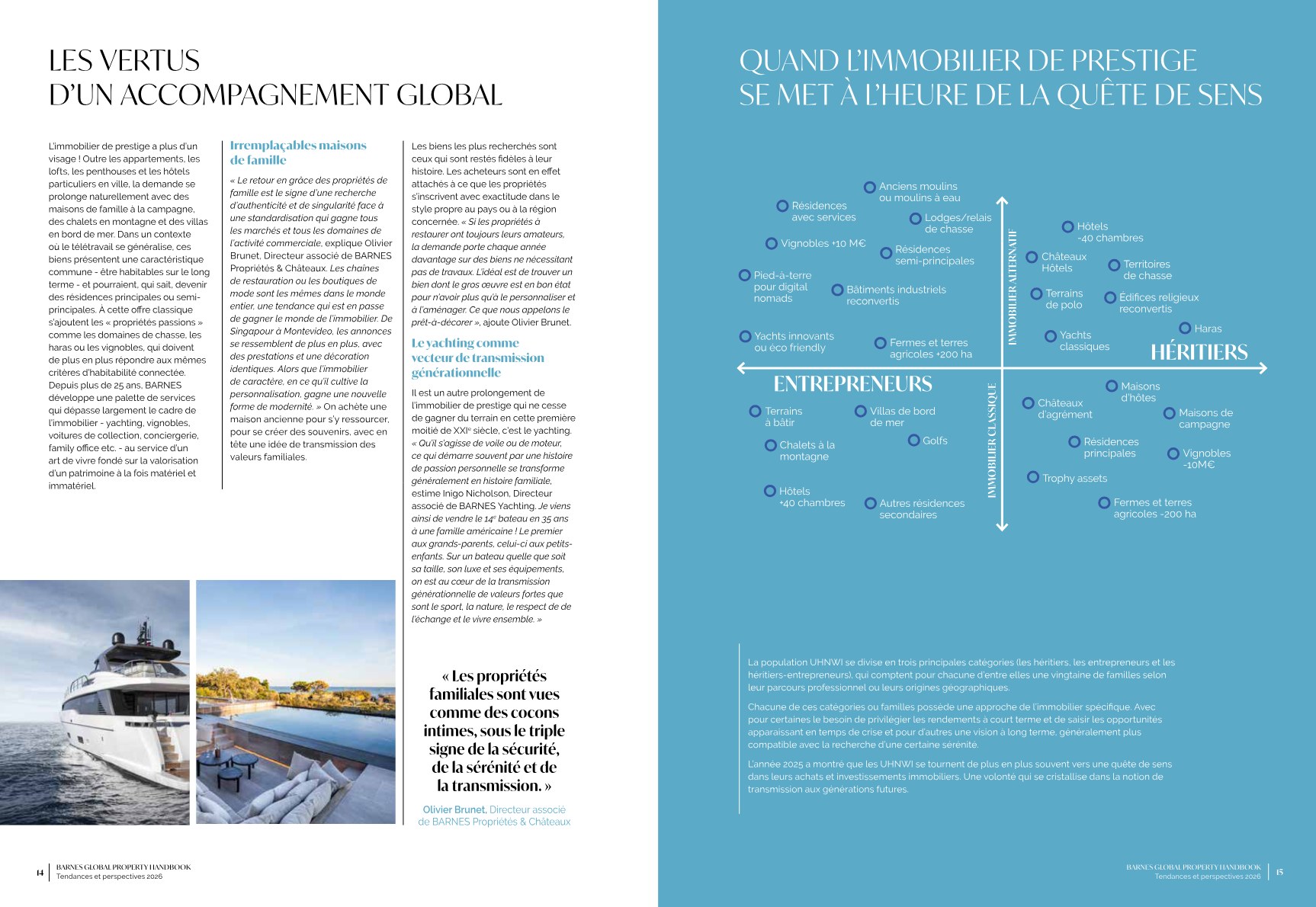
The UHNWI population can be divided into three main categories—heirs, entrepreneurs, and heir-entrepreneurs—each comprising roughly twenty families, defined by their professional background or geographical origins. Each category, and indeed each family, has a specific approach to real estate. The year 2025 demonstrated that UHNWI are increasingly guided by a search for meaning in their real estate purchases and investments—a desire that often crystallizes around the concept of passing assets on to future generations.
"Family estates are seen as intimate havens, embodying security, serenity, and the transmission of values." — Olivier Brunet, Associate Director, BARNES Properties & Châteaux