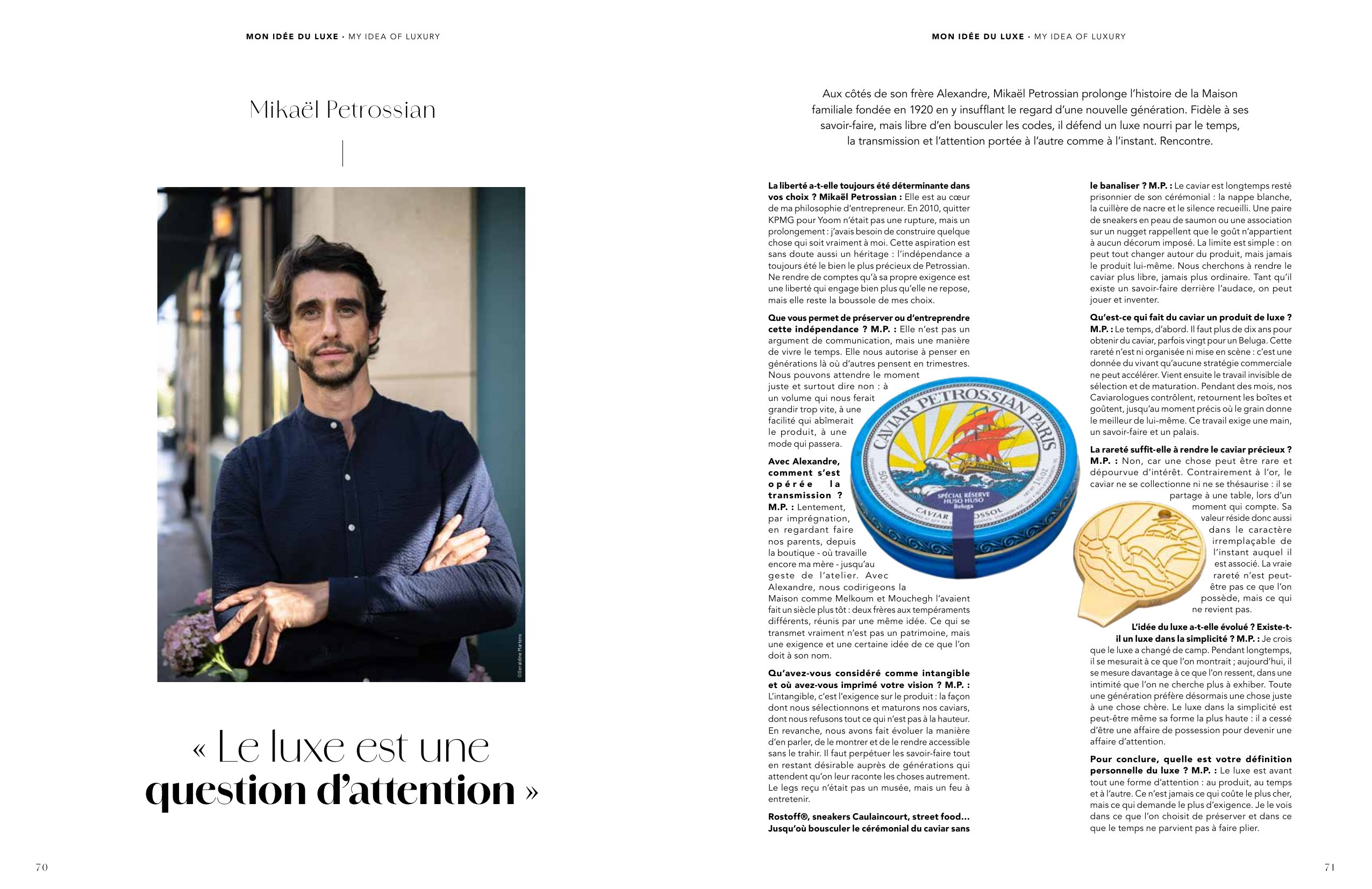
Has freedom always guided your decisions?
Mikaël Petrossian: It lies at the heart of my philosophy as an entrepreneur. In 2010, leaving KPMG for Yoom was not a break, but a natural continuation: I needed to build something that was truly my own. That aspiration is undoubtedly part of my heritage, too: independence has always been Petrossian's most precious asset. Answering only to your own exacting standards is a freedom that brings far more responsibility than comfort, but it remains the compass guiding my choices.
What does that independence allow you to preserve, and to pursue?
M.P.: It is not a marketing claim, but a way of relating to time. It allows us to think in generations where others think in quarters. We can wait for the right moment and, above all, say no: to production volumes that would force us to grow too quickly, to shortcuts that would compromise the product, or to a passing trend.
How did the transition from one generation to the next unfold for you and Alexandre?
M.P.: Slowly, by osmosis, by watching our parents at work, both in the boutique, where my mother still works, and through every precise gesture in the atelier. Alexandre and I now lead the House together, just as Melkoum and Mouchegh did a century ago: two brothers with different temperaments, united by a shared vision. What is truly passed down is not an inheritance, but a standard of excellence and a certain understanding of what one owes to one's name.
What did you consider non-negotiable, and where did you make your own mark?
M.P.: What remains non-negotiable is our standard for the product: the way we select and mature our caviars, and our refusal to accept anything that falls short. What we have changed is the way we talk about it, present it and make it accessible without betraying it. The challenge is to preserve the savoir-faire while continuing to appeal to generations that expect stories to be told differently. What we inherited was not a museum, but a flame to keep alive.
Rostoff®, Caulaincourt sneakers, street food… How far can you challenge the rituals of caviar without making it ordinary?
M.P.: For too long, caviar remained trapped in its own ceremony: the white tablecloth, the mother-of-pearl spoon and reverent silence. A pair of sneakers made from salmon leather, or caviar paired with a chicken nugget, reminds us that taste belongs to no prescribed setting. The rule is simple: everything around the product can change, but never the product itself. We want to make caviar freer, never more ordinary. As long as boldness is backed by genuine savoir-faire, there is room to play and create.
What makes caviar a luxury product?
M.P.: Time, first and foremost. It takes more than ten years to produce caviar, and sometimes twenty in the case of Beluga. This rarity is neither engineered nor staged: it is a fact of nature that no marketing strategy can accelerate. Then comes the invisible work of selection and maturation. For months, our Caviarologists® monitor and turn the tins, tasting the caviar until the precise moment its pearls reach their peak. This work requires precision, expertise and a trained eye.
Is rarity alone enough to make caviar precious?
M.P.: No. Something can be rare and still hold no real interest. Unlike gold, caviar cannot be collected or hoarded: it is shared around a table, at a moment that matters. Its value also lies in the irreplaceable nature of the moment it comes to embody. True rarity may not lie in what we possess, but in what can never be repeated.
Has the idea of luxury evolved? Can simplicity itself be luxurious?
M.P.: I believe the meaning of luxury has shifted. For a long time, it was measured by what we displayed. Today, it is increasingly defined by what we feel in private, with no need to put it on display. An entire generation now favors what feels right over what is merely expensive. Luxury expressed through simplicity may even be its highest form: it is no longer about possession, but about attention.
Finally, what is your personal definition of luxury?
M.P.: Luxury is above all a form of attention: to the product, to time and to others. It is never what costs the most, but what demands the highest standards. I see it in what we choose to preserve, and in what even time cannot bend.