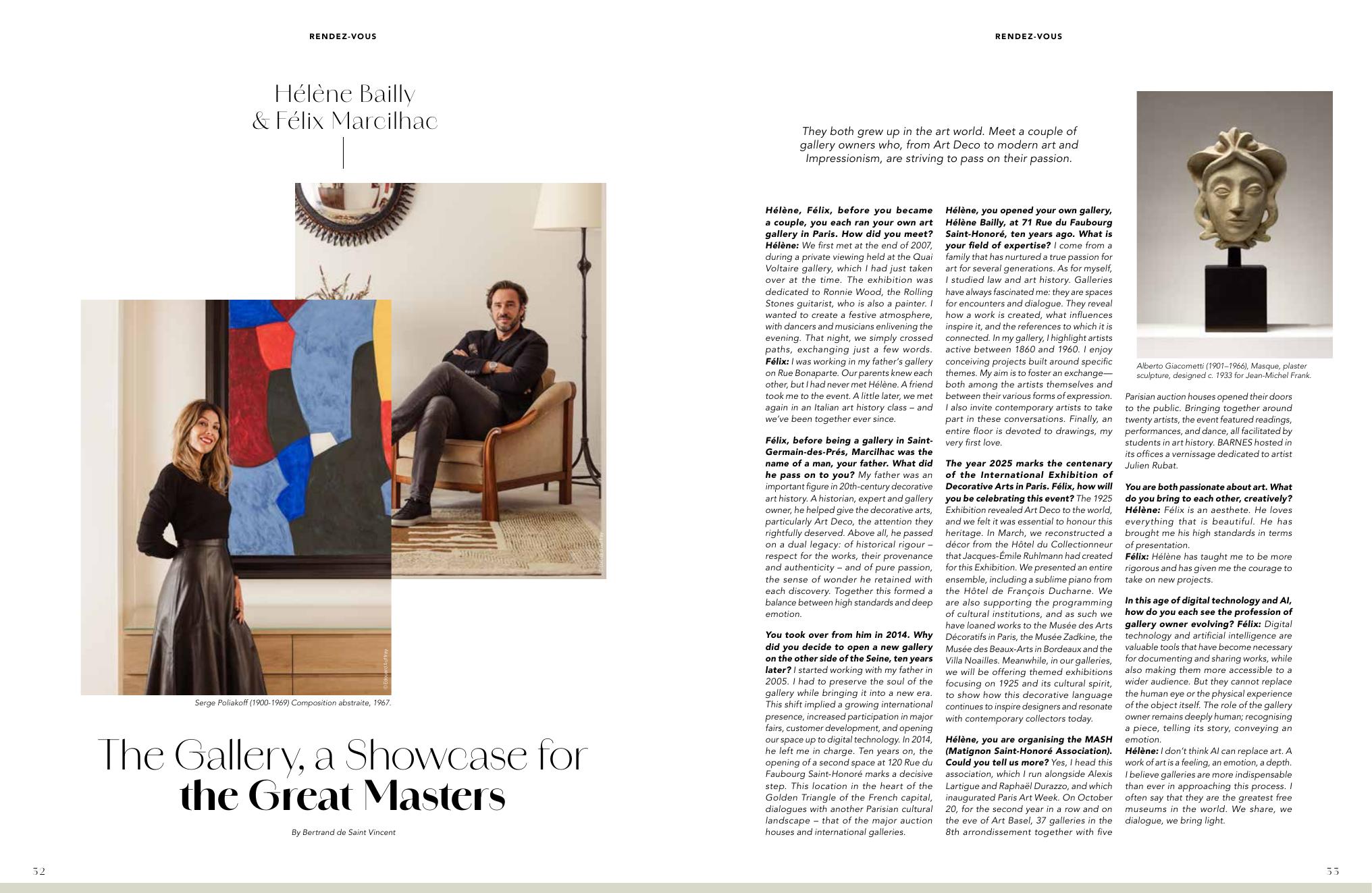
Hélène, Félix, before you became a couple, you each ran your own art gallery in Paris. How did you meet?
Hélène: We first met at the end of 2007, during a private viewing held at the Quai Voltaire gallery, which I had just taken over at the time. The exhibition was dedicated to Ronnie Wood, the Rolling Stones guitarist, who is also a painter. I wanted to create a festive atmosphere, with dancers and musicians enlivening the evening. That night, we simply crossed paths, exchanging just a few words.
Félix: I was working in my father's gallery on Rue Bonaparte. Our parents knew each other, but I had never met Hélène. A friend took me to the event. A little later, we met again in an Italian art history class – and we've been together ever since.
Félix, before being a gallery in Saint-Germain-des-Prés, Marcilhac was a man: your father. What did he pass on to you?
My father was an important figure in the history of 20th-century decorative arts. He contributed to the rediscovery and promotion of Art Deco at a time when the movement was still little recognised. We felt it was essential to pay tribute to this heritage. In March, we recreated a setting from the Hôtel du Collectionneur that Jacques-Émile Ruhlmann had designed for the 1925 Exhibition. We presented an entire ensemble, including a sublime piano from the Hôtel de François Ducharne.
We also support the programming of cultural institutions: we have loaned works to the Musée des Arts Décoratifs in Paris, the Musée Zadkine, the Musée des Beaux-Arts in Bordeaux, and the Villa Noailles. In our galleries, we will present thematic exhibitions around 1925 and its spirit, to show how this decorative language continues to inspire creators and resonate with contemporary collectors.
Hélène, you opened your own gallery, Hélène Bailly, at 71 Rue du Faubourg Saint-Honoré, ten years ago. What is your field of expertise?
I come from a family that has nurtured a true passion for art for several generations. As for myself, I studied law and art history. Galleries have always fascinated me: they are spaces for encounters and dialogue. They reveal how a work is created, what influences inspire it, and the references to which it is connected. In my gallery, I highlight artists active between 1860 and 1960. I enjoy conceiving projects built around specific themes. My aim is to foster an exchange — both among the artists themselves and between their various forms of expression. I also invite contemporary artists to take part in these conversations. Finally, an entire floor is devoted to drawings, my favourite medium for understanding an artist's creative process.